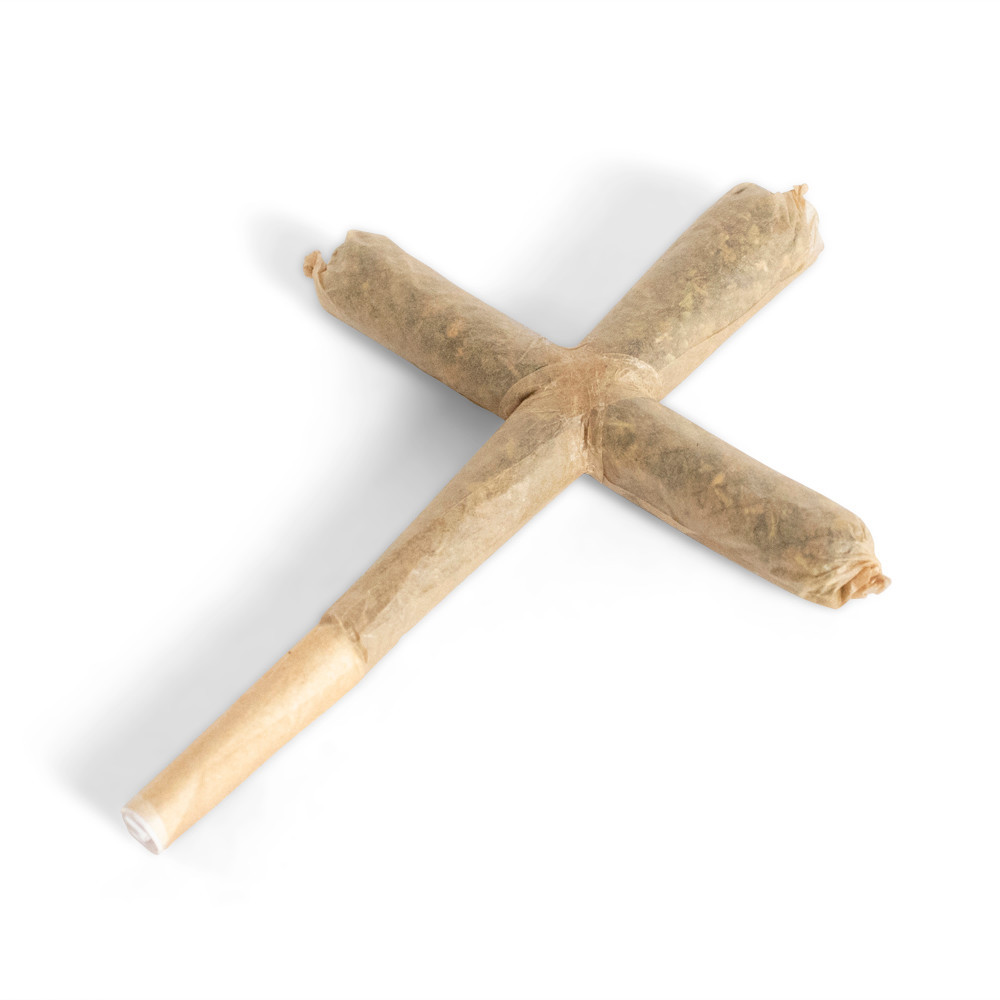
What is a cross joint? It’s two joints built into one shape: a thicker main piece with a slimmer one run through the middle, so you end up with three burning tips instead of one. Light all three at once and the smoke meets in the middle. That’s the whole trick. It looks like a plus sign. It smokes like a small event.
Most people first saw one in Pineapple Express. James Franco’s character called it the apex of joint engineering. Seth Rogen didn’t invent it—he just put it on a movie screen. The form was already floating around parties and old rolling handbooks long before 2008. The movie just made sure nobody could pretend they hadn’t heard of it.
At NativeCare we grow and sell flower meant to be smoked, not just photographed. A cross joint is still a flex. It’s also a fast way to go through 1.5–2 grams. Treat it like a shared moment, not a solo weekday habit.
What you actually need
- 1.5–2 grams of well-cured flower (something with structure, not dusty shake)
- One king-size paper
- Two standard papers
- A grinder
- A thin poker (toothpick, paperclip, skewer)
- Scissors
- A crutch / filter tip for the main joint (worth it)
- A little patience
Grind to a medium. Too fine and the main joint collapses when you punch the hole. Too chunky and air won’t move.
1. Build the main joint first
This one has to be fatter than your usual roll. You’re about to put a hole through it, so it needs walls.
Add a filter. Load the king-size paper a little heavier than you think. Shape it, tuck, seal, twist the ends. Pack it firm—not rock-hard, not loose. If you squeeze it and it feels like a marshmallow, start over. Soft joints tear.
2. Roll the cross piece
Standard paper. Thinner. No filter. Seal it tight and twist both ends so it stays a clean cylinder. This piece has to slide through a hole without shredding either paper.
3. Make the hole
This is where most people ruin a good roll.
Find the center of the main joint. Work the poker in slowly, rotating more than you shove. Open the hole just wide enough for the thin joint—no bigger. If you blow it out, the seal is gone and the whole thing becomes a leaky sculpture.
Optional but useful: poke a small hole through the middle of the thin joint as well, so air can actually travel between the two chambers. Skip that and one arm often canoe while the other sits there looking pretty.
4. Assemble and tape it like you mean it
Slide the thin joint through until the arms are even. Cut your third paper into narrow strips. Use the gummed edge. Wrap the intersection from every angle—front, back, both “armpits.” This isn’t decoration. It’s the only thing keeping air from dumping out the sides when you light it.
Let the gum dry. Don’t rush that part.
Before you celebrate, draw air from the filter. You should feel pull from all three tips. If one side is dead, the hole alignment is off or the wrap is choking it.
5. Light it like the movie said
All three ends at the same time. That’s the point. If you only light the main tip, you built a novelty, not a cross joint.
It will burn faster than a regular joint. Pass it. Don’t treat it like a personal cannon.
What usually goes wrong
- Hole too big → leaks, harsh pull, sad unwrapping mid-session
- Intersection not wrapped enough → it splits the first time someone hits it
- Uneven pack → one arm races, the other sulks
- Flower ground to powder → the main joint caves when you pierce it
First attempts look ugly. That’s normal. Even people who roll all day miss these more often than they admit.
If you want to get extra
Different colored papers. A different strain in the cross piece than the main. A second cross if you enjoy suffering. None of that matters if the seal is weak.
Or skip the craft project and grab a NativeCare full-flower pre-roll. Same flower, no engineering degree required. We still respect the people who can build the cross. We just don’t pretend it’s the most efficient way to enjoy what we grow.
A good cross joint isn’t about getting more high. It’s about making something that looks like you cared, then sharing it before it turns into ash. That’s the whole craft.
Practice on a quieter night. Bring the finished one out when the table’s ready.